AI Automations for Growth Teams
Production AI deployments — not roadmaps. Claude-powered chat widgets, semantic knowledge bases, agentic coding workflows, and operational automations shipped end-to-end.
What is "production AI automation"?
Production AI automation is software running in front of real users that uses a large language model to do work the team would otherwise do manually — answer support questions, classify content, generate structured outputs, write or review code, run scheduled reporting. The defining property is that it ships and stays shipped: the API key is held server-side, the latency is acceptable, the outputs are deterministic enough for production, and the cost is predictable.
Most teams have an "add AI" line on the roadmap and a stalled prototype that never made it to users. The gap between prototype and production is rarely the model — it is the surrounding infrastructure: secret management, semantic content preparation, prompt-cache strategy, fallback behavior, observability, and the integration with the existing stack. Engagements here close that gap by shipping the deployed thing rather than recommending which vendor to evaluate.
The four engagement archetypes
Most AI automation work for growth teams maps to one of four shapes. Each follows the same delivery principle — the engagement ends with deployed software, not a deck — but the artifacts and timeline differ.
1. Claude-powered chat widget & knowledge base install
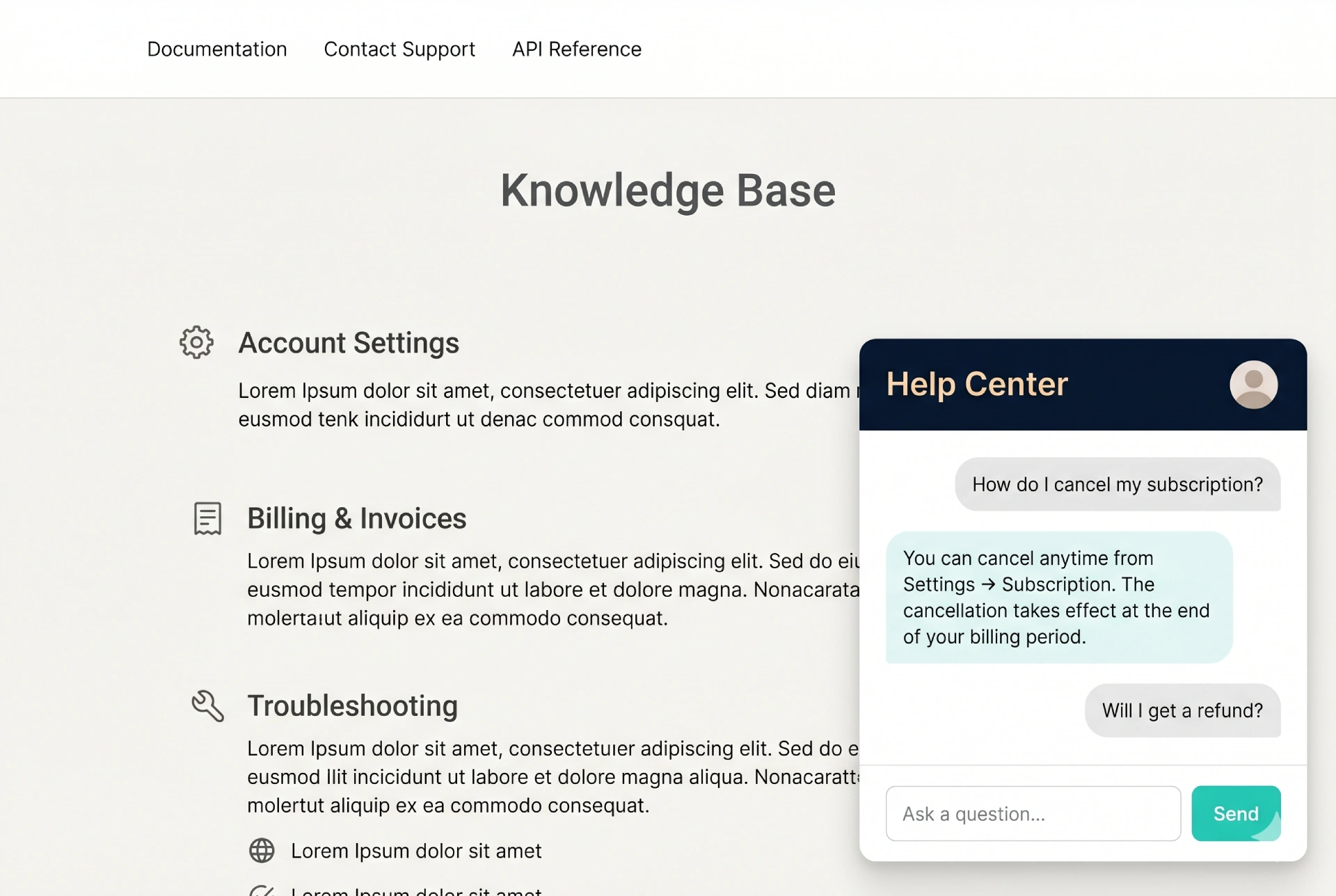
A help center, terms of service, FAQ, and other support content is restructured into a semantically chunked JSON knowledge base with metadata tags for category, keywords, and source. A Claude-powered chat widget is built with Vercel Edge functions (keeping the API key server-side), a pattern-matching fallback layer for offline or rate-limited cases, and a brand-matched UI. The widget embeds via a single script tag on Webflow, WordPress, Framer, or any other static stack — no infrastructure changes required. Standard deployment runs concept to production in under two weeks. Outcome: real-time customer self-service that absorbs a meaningful share of tier-1 support volume and frees agents for genuine product issues.
2. Claude Code & agentic skill packs
For product and engineering teams wanting to multiply output with agentic workflows, custom SKILL.md files encode team-specific architecture, conventions, and workflows that an agentic coding tool follows on every task. A starter pack typically includes planning, test-driven development, code review, debugging, and deployment skills. The skill files are committed to the team's repository, version-controlled like any other source code, and cross-compatible with Claude Code, Antigravity, and Cursor. The two-week sprint includes a workshop component so the team can author and maintain new skills after the engagement ends — the goal is durable internal capability, not dependency on the consultant.
3. Operational AI automations
Many growth-team workflows are repeatable but expensive to staff: classifying inbound affiliate applications, scoring support tickets for escalation, generating ad-creative variants from a campaign brief, summarizing weekly subscription metrics into an executive-ready report, reviewing privacy-policy or terms-of-service drafts against a checklist. Each of these can be replaced by a small automation that calls Claude on a schedule or webhook. The architecture is consistent across cases: an event source (cron, webhook, queue), an edge function that prepares the prompt with the right context and prompt-cache strategy, a structured-output schema, and a destination (database, Slack channel, dashboard). The resulting automation runs unattended and produces auditable outputs.
4. AI integration audit
For teams already shipping AI features who suspect the implementation is leaving capability on the table, the audit reviews prompt construction, model selection, prompt-cache hit rates, latency, error handling, and unit economics. Most production deployments I have audited have at least one of three common gaps: missing prompt caching (a 10x cost difference for long-context workloads), no fallback path when the API is rate-limited or unreachable, and structured-output prompts that drift over time without versioning. The audit produces a remediation list ranked by cost or quality impact, with concrete diff-level recommendations for the team's existing code.
Why most "AI on the roadmap" stalls
The pattern is consistent across SaaS and subscription apps: a feature is scoped, a prototype gets to a demo, and then it never ships. The blocker is rarely the model itself — it is the surrounding infrastructure that production requires. API keys cannot live in the browser bundle, so a serverless edge function has to be set up, monitored, and rate-limited. Long-context prompts need cache strategies or unit costs spiral. Outputs need to be structured (JSON schema, function calling, or constrained generation), versioned, and observable so regressions are caught when prompts drift. Fallback behavior has to exist for the 0.5% of requests where the API is unreachable, or the feature dies on the first incident. None of this is hard, but each piece needs to be in place before the prototype becomes a product. Engagements here ship the full set, not just the model call.
Where AI is not the right tool yet
AI multiplies existing repeatable processes; it does not invent missing ones. Workflows that have inconsistent inputs, no documented success criteria, or require expert judgment on every output usually produce worse results when automated than the human baseline. The honest recommendation in those cases is to build the process first — document the inputs, define what "good" looks like, run it consistently for a quarter — and then automate. A second category to avoid: anywhere the cost of a wrong answer is high and the output cannot be reviewed before it reaches a customer (legal copy, regulated communications, financial calculations affecting payment). For these, a human-in-the-loop pattern is acceptable; full automation usually is not. Saying no is part of the engagement.
What you receive
- ✓ Deployed software: running in your stack, owned by your team, source code committed to your repository.
- ✓ Edge function or serverless deployment: with secret management, request validation, and rate-limit handling configured.
- ✓ Semantic knowledge base or content pipeline: for chatbot work, the chunked JSON corpus and the ingestion script for future content updates.
- ✓ SKILL.md pack or automation runbook: for agentic and operational engagements, the documented files and workflow your team uses to extend the system.
- ✓ Observability and cost guardrails: logging, prompt-cache configuration, and unit-cost projections so the deployment is not a budget surprise.
Frequently asked questions
Deployed software running in production — a Claude-powered chat widget on a live help center, a knowledge base served from edge functions, SKILL.md files committed to the team's repository, or an automation running on a schedule. Not a strategy deck, not a vendor recommendation, not a prototype that never ships.
The Claude API key never touches the frontend. The widget calls a Vercel Edge function (or equivalent serverless edge runtime) that holds the key as an environment variable, validates the request, and forwards it to Anthropic. The browser bundle has no secret material. This pattern works on Webflow, WordPress, Framer, or any static-rendered site without infrastructure changes.
A SKILL.md file is a structured Markdown document that encodes team-specific architecture, conventions, and workflows for an agentic coding tool to follow. It tells the agent which files to look at, which patterns to reuse, which tests to run, and what acceptance criteria to apply. SKILL.md files are cross-compatible with Claude Code, Antigravity, and Cursor.
Concept to production in under two weeks, standard. Week one: content restructuring into a semantically chunked JSON knowledge base and edge-function setup. Week two: widget design, brand integration, fallback behavior, and embedding via a single script tag. Webflow, WordPress, and similar stacks need no infrastructure changes.
Anywhere the inputs are still manual or the outputs need full human review. AI is a force multiplier on existing repeatable processes, not a substitute for missing ones. If a workflow has inconsistent inputs, no documented success criteria, or requires expert judgment on every output, building the process first is the right move — automation comes after.
Claude (Anthropic) is the default for production work because the latency, instruction-following, and tool-use behavior fit the workloads I deploy. The deployment architecture is portable — the same edge-function pattern, knowledge-base structure, and prompt-cache strategy works if a client requires a different vendor.
Stop talking about AI. Start shipping it.
Book a discovery call to scope the smallest deployable AI automation for your team and have it in production within two weeks.